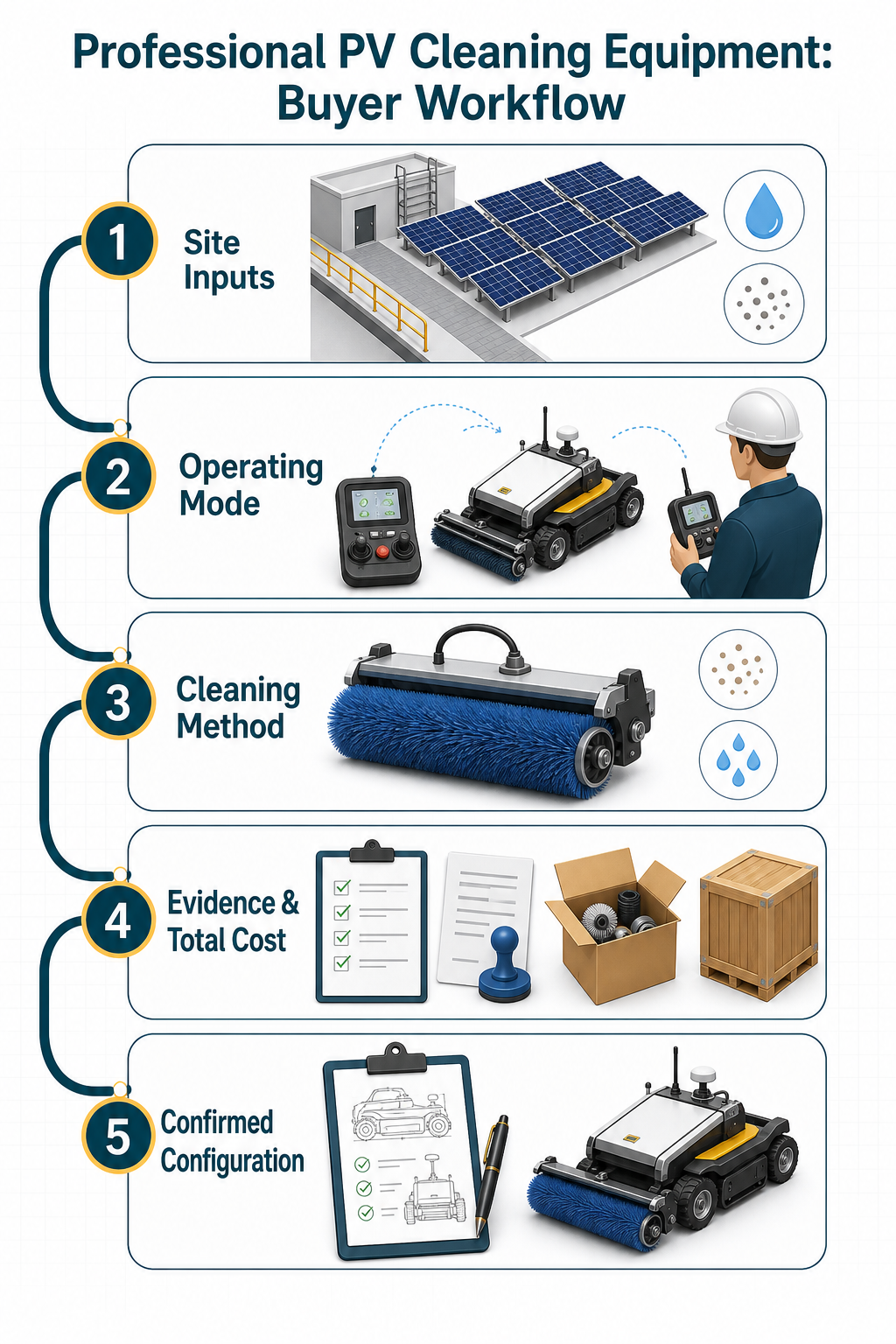
Buying professional solar panel cleaning equipment starts with the site and the acceptance criteria—not with a brochure comparison. A useful RFQ records the array layout, access, contamination, utilities, operating method, required documents and commercial scope. It then asks every supplier to evidence the same fields under the same test conditions.
This guide gives EPC, O&M, distributor, engineering-procurement and asset-management teams a practical comparison framework. It is not a fixed product recommendation, price list, legal opinion, import advice or certification determination.
1. Start With the Site, Not the Product
The same cleaning equipment category may suit one array and be unsuitable for another. Before asking for a model or a budgetary quotation, define the physical route, operating constraints and scope of work. Give every shortlisted supplier the same site information so that the proposals can be compared fairly.
| Requirement | Evidence to request | Acceptance check |
|---|---|---|
| PV application and project scope | Site type, country or region, project stage, target quantity and intended operating window. | The proposal states its assumptions and identifies missing inputs. |
| Array geometry | Module dimensions, structure, row length, tilt, gaps, height changes and drawings. | Any stated compatibility is tied to the supplied geometry and a named configuration. |
| Access and handling | Roof or ground access, pathways, obstacles, row changes, lifting and transport limits. | Handling, installation and transfer steps are feasible for the actual site. |
| Soiling and cleaning objective | Contamination type, recurrence, current cleaning method, photos and desired cleaning window. | The proposed method explains its limits for the documented contamination. |
| Water, environment and operation | Water source and quality, drainage, temperature, wind, salt exposure, power or charging, personnel and preferred operating mode. | Environmental and safety assumptions are stated; unknown items remain open, not guessed. |
A product category shown before review is not a final compatibility approval. If information is incomplete, label it Not confirmed and request a site review rather than filling the gap with an estimate.
2. Define the Operating Mode Precisely
Words such as automatic and robotic are not sufficient procurement requirements. The RFP should define who places equipment, who starts and supervises it, how it moves between rows, what happens at an obstruction and what the operator must do during a fault.
| Operating mode | What the procurement team should define | Do not infer |
|---|---|---|
| Handheld | Operator position, reach, brush or tool interface, access and fall-protection requirements. | That a handheld tool has remote, assisted or autonomous capability. |
| Remote-controlled | Who places the unit, control range and conditions, line of sight, communications, supervision and stop procedure. | That remote control means unattended operation. |
| Assisted | The functions assisted by the equipment and the functions retained by the operator. | That assistance removes site-specific safety responsibilities. |
| Automatic | Defined automated steps, route boundaries, start conditions, exception handling and recovery procedure. | That all transfers, obstructions and weather decisions are automated. |
| Unattended | Only use this term when the specific model, deployment and safety case have been confirmed in writing. | That a generic product category supports unattended operation. |
Request a written operating sequence, a site-specific risk review and a demonstration or comparable evidence for the claimed operating mode. Include weather, electrical isolation, access control and fall-protection responsibilities in the project procedure; these are not resolved by the equipment label alone.
3. Compare the Cleaning Method Against the Soiling
Professional solar panel cleaning equipment is commonly evaluated as dry, wet or dry-wet cleaning. The choice should reflect the documented contamination, water availability, water quality, drainage, module-maker guidance and the proposed brush or contact materials.
- Dry cleaning: ask how dust is removed or contained, what brush material contacts the module and what conditions make the method unsuitable.
- Wet cleaning: ask for the water path, required water quality, drainage controls, method for persistent residue and all weather or electrical restrictions.
- Dry-wet cleaning: ask which stage uses water, how the sequence changes for site conditions and how cross-contamination or residue is managed.
Do not accept a blanket claim that any method works for every stain or every PV module. For heavy deposits, chemicals, coatings or unusual environmental exposure, request the applicable cleaning instructions and confirm the method with the relevant project, module and engineering parties.
4. Build a Comparable Specification Sheet
A specification value is useful only when it identifies the product configuration and the test conditions. Ask suppliers to complete the same comparison sheet rather than combining isolated figures from marketing materials.
| Field to compare | Required context | Acceptance check |
|---|---|---|
| Working width, travel speed and coverage | Named model/configuration, module layout, operating mode, test surface and measurement method. | Values are comparable and not treated as a site-output guarantee. |
| Slope, obstacle and row transition capability | Geometry, surface condition, load, transition method, supervision and test setup. | The claim matches the actual array rather than a generic maximum. |
| Weight, dimensions and handling | Complete delivery configuration, battery or accessories included, lifting method and operator count. | Site access and structural constraints are addressed. |
| Battery, charging and ingress protection | Model-specific document, operating conditions, test standard, document version and validity. | No IP rating is extrapolated to every climate or application. |
| Water use, staff and transfer time | Cleaning mode, input water conditions, task boundary, site layout and measurement window. | Inputs can be used in a project calculation without inventing savings. |
5. Request Evidence, Not Labels
Certificates, test reports, product photographs and packing images may be relevant to procurement, but a logo or a short claim is not sufficient evidence. Ask for readable documents that identify the scope, linked product or process, issuing or testing body, date or version and document status.
| Evidence category | What to request | What to verify |
|---|---|---|
| Product and configuration | Model identification, data sheet, manuals, configuration list and labelled photos. | The document refers to the same configuration proposed in the quotation. |
| Testing and protection | Relevant test reports, declared rating, test conditions and validity. | Scope, product identity and stated application boundary; do not generalise a rating to unrelated conditions. |
| Battery and shipment | Battery transport documents, packaging information and shipment-document list where applicable. | The items match the battery and destination requirements for the actual order. |
| Manufacturing and inspection | Factory audit material, pre-shipment or factory-test records and quality documentation when available. | Issuer, date, scope, public-release status and contract applicability. |
| Market or tender documents | Document list required by the purchaser or tender. | Whether third-party review, legalization, notarization or additional work must be agreed before order confirmation. |
6. Calculate Total Cost of Ownership
A useful total-cost comparison separates the equipment price from the project inputs that vary by configuration, destination and service scope. Do not use a fixed ROI, maintenance percentage, water-saving percentage or payback period unless the calculation method, baseline, timeframe and site conditions are documented for that project.
- Base equipment and configuration-specific options
- Consumables and recommended spare-parts list
- Battery, charger, remote control, water system, charging or docking equipment where applicable
- Packaging, freight, insurance, taxes, customs duties and destination handling
- Installation, commissioning, training, remote guidance and on-site support scope
- Planned maintenance, downtime assumptions, replacement parts and operating labour
Ask suppliers to state Incoterms, quotation currency, validity period, inclusions, exclusions and optional items in the formal quotation. Delivery lead time, payment terms, warranty, installation, training, freight and local support should be confirmed at order or quotation level—not assumed from a general guide.
7. Twelve Questions for a Solar Cleaning Equipment Supplier
- Which site inputs are required before you can confirm a configuration?
- Which model and options are proposed, and what assumptions does the proposal rely on?
- What is the exact operating sequence, including placement, supervision, transfer and fault recovery?
- Which cleaning method and contact materials are proposed for the documented contamination?
- Which specifications are measured, under which conditions and on what configuration?
- What physical constraints, exclusions or unconfirmed items remain?
- Which product, testing, shipment and quality documents can be supplied for this order?
- Which documents require prior agreement, third-party review or market-specific confirmation?
- What is included in the equipment package and which items are optional?
- Which consumables and spare parts are recommended, with quantities and replacement criteria?
- What are the agreed Incoterms, packaging, freight, tax and destination responsibilities?
- What are the confirmed training, commissioning, warranty and after-sales responsibilities?
8. Shortlist, Review the Site, Then Confirm the Configuration
Use the first comparison to create a shortlist—not a final award. Share the validated site data; review physical, environmental and safety constraints; compare standard or custom paths; then confirm the equipment configuration, options, documents, quantity, delivery and support scope in the commercial proposal.
For an equipment-category overview, compare solar panel cleaning equipment categories. You can also evaluate a solar cleaning robot manufacturer in China, verify product and shipment documentation, or review procurement and quotation FAQs.
Discuss Your PV Cleaning Project
Share the site type, array layout, module dimensions, access, contamination, water conditions, preferred operating method, quantity and delivery market. The project team can then discuss relevant standard or custom equipment paths.
Submit Site Information for Equipment Review
Final suitability, specifications, delivery and support scope are subject to engineering and commercial confirmation.
Editorial boundary: This guide is a procurement framework. It does not provide legal, electrical-safety, import-compliance, product-compatibility, output-recovery, ROI or performance guarantees.