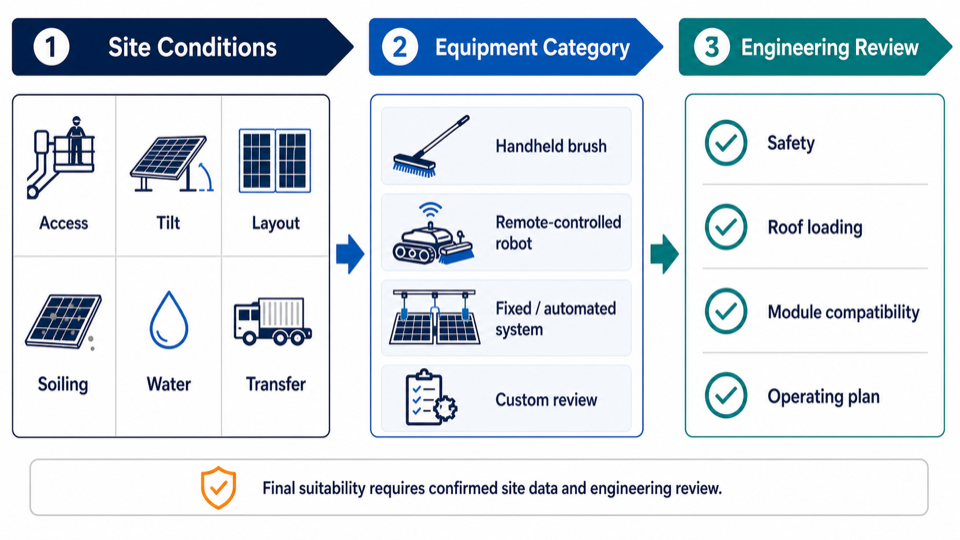
Commercial solar panel cleaning equipment should be compared against the actual rooftop—not selected from a product list alone. Access routes, module tilt, array layout, contamination, available water, transfer between roof zones and the intended operating mode all affect which equipment category is worth reviewing. A suitable configuration is confirmed only after site data and engineering review.
For commercial and industrial PV owners, EPCs, O&M teams and procurement teams, the practical question is not simply “which cleaner is best?” It is which equipment can be safely planned, moved, operated and maintained within the conditions of a particular roof. This guide provides a condition-based framework for comparing commercial solar panel cleaning equipment. It does not replace roof-safety review, structural review, electrical procedures or model-specific product confirmation.
Why Commercial Rooftops Need a Different Equipment Review
A commercial rooftop can contain multiple array sections, service corridors, HVAC equipment, skylights, drainage points, cable routes and changes in access between zones. An industrial roof may also have production constraints, restricted operating windows or pollution sources that change the cleaning challenge. These details can affect how equipment is brought to the roof, where it can be placed, how operators work around obstacles and how cleaning is planned across the full array.
As a result, an equipment category that is reasonable for one regular array may not be appropriate for another. A preliminary product comparison should identify the conditions that need verification; it should not make a remote promise about roof loading, fall protection, module compatibility, slope, obstacle crossing, water pressure or unattended operation.
Define the Cleaning Challenge Before Comparing Equipment
Start by documenting what is on the modules and what may affect the cleaning process. Dry dust, industrial particulate, oily residue, bird droppings, salt exposure and mineral deposits can require different cleaning methods, water arrangements and maintenance planning. The roof surface, drainage arrangement and local operating constraints also matter.
- Contamination: Describe the observed material, its location, the recurrence pattern and any known source.
- Module and array layout: Record module dimensions, rows, gaps, frame details, rails, edge zones and obstructions.
- Roof access: Include lift or stair access, carrying routes, set-down areas, walkways and transfer points between array zones.
- Operating constraints: Note site access rules, work windows, electrical procedures, personnel requirements and weather restrictions set by the project owner.
Do not assume that a cleaning method or equipment type is universally suitable for BIPV, flexible modules, unusually configured arrays or other non-standard installations. Those conditions require model-specific and project-specific review.
Match the Equipment Category to the Conditions You Need to Review
| Site condition | Equipment category to compare | Engineering check |
|---|---|---|
| Small, distributed, edge or difficult-to-reach array sections | Handheld electric brush | Operator access, working position, water/electrical arrangement, module-contact method and safe movement route. |
| Regular array sections where an operator can supervise and take control | Remote-controlled mobile robot | Array geometry, gaps, rails, edge treatment, transfer plan, operating visibility and model-specific safety features. |
| Arrays with repeatable paths, planned docking and maintainable infrastructure | Fixed or automated system | Confirmed path, docking, power/water arrangement, maintenance access, safety controls and model-specific operating limits. |
| Special layouts, unusual roof geometry or unverified application conditions | Custom engineering review | Whether a standard category is appropriate at all, followed by configuration and safety review. |
A handheld electric brush can be useful to compare for small areas, distributed arrays or edge sections where direct operator control is needed. Remote-controlled mobile equipment can be evaluated for more regular arrays, provided that the operator’s supervision, transfer between zones and the equipment’s verified limits are addressed. Fixed or automated systems should be considered only after the array, docking, path and maintenance conditions have been confirmed. For unusual layouts, the next step is an engineering review—not a generic product recommendation.
Choose Dry, Wet or Combined Cleaning With the Full Site Context
Cleaning equipment is not selected independently from the cleaning method. Water availability, water quality, drainage, likely deposits and site procedures influence whether dry, wet or combined cleaning is appropriate to assess. Any cleaning medium, water pressure, chemical use, module-temperature condition and electrical procedure must be reviewed against the applicable manufacturer instructions and project safety requirements.
| Method to assess | Conditions to document | Limits to review |
|---|---|---|
| Dry cleaning | Loose dust level, recurring source, access for equipment and expected cleaning frequency. | Whether the observed contamination can be addressed without water; module-contact method and dust-management procedures. |
| Wet cleaning | Water source, water quality, supply route, drainage, deposits and permitted work conditions. | Water use, runoff, mineral residue, pressure, electrical procedures and manufacturer guidance. |
| Combined cleaning | Variation in contamination across zones, equipment changeover requirements and site operating plan. | Whether the combined process is necessary and safely manageable under the project’s verified conditions. |
Commercial solar panel washing may be relevant where wet cleaning is appropriate, but water alone does not establish a suitable process. The project team should confirm supply, drainage, water-quality controls and all relevant roof, electrical and safety procedures before a wet method is specified.
Check Access and Transfer Between Roof Zones
Equipment performance on a single array row is only one part of a commercial deployment. The review should also cover how equipment and operators reach the roof, move along approved routes, transfer between array zones and leave the site after use. Document stairs, lifts, hatches, walkways, cable crossings, gaps, edge conditions, set-down areas and any restrictions created by rooftop equipment.
Fall protection, roof loading, high-tilt arrangements, obstacle crossing, ingress protection and operating mode must be confirmed against the selected model, installation method and site procedures. They should not be inferred from a product category or article illustration.
Use a Consistent Pre-Comparison Checklist
When several roof zones are involved, collect the same information for each zone rather than treating the site as one uniform array. A roof may have different module layouts, contamination patterns, access points or operating restrictions on the same building. Label photographs and drawings by zone so that the review team can connect each condition to a proposed operating method.
- Access and staging: Where will people and equipment enter, be staged and leave the roof? Are these routes approved for the intended activity?
- Array boundaries: Where do rows begin and end, and what happens at perimeter, edge, drainage and transition areas?
- Handling plan: Can equipment be transferred safely and practically between sections without relying on an unverified crossing method?
- Resource plan: If water or power is needed, where does it come from, how is it routed and what site controls apply?
- Maintenance plan: Who inspects, stores, cleans and maintains the equipment between operating cycles?
- Escalation points: Which unknowns require the roof owner, structural professional, electrical professional, module manufacturer or equipment engineering team to respond?
This checklist does not create an approval. It makes the discussion more efficient by separating observed facts from assumptions that still need confirmation. If any input is unclear, keep it open in the site review package rather than converting it into a claimed equipment capability.
Build a Site Review Package
A structured site package helps an equipment supplier and project team compare categories without guessing. Share the following information before requesting a proposed configuration:
- Recent overview and close-up photographs of each array zone, access route and obstacle.
- Roof and array drawings, where available, including dimensions, module arrangement, row gaps, rails and edge details.
- Module dimensions, mounting information, tilt and any known non-standard components.
- Approximate array area, number of zones and the preferred cleaning frequency or operating window.
- Observed contamination, local conditions and any restrictions on water, drainage or cleaning materials.
- Available water and power information, plus site access, safety and electrical requirements.
From Site Conditions to a Confirmed Configuration
After receiving the site package, the review can move from broad comparison to a confirmed configuration. First, screen the array and access conditions against the equipment categories. Next, identify any information gaps, safety constraints or custom-engineering needs. Then confirm the selected product configuration, operating mode, accessories, transfer method and project scope with the responsible technical and commercial teams.
This process is designed to make the decision traceable. It avoids giving a false-precision model recommendation before the roof, modules, operating plan and safety requirements are known.
For procurement, record why each alternative was included or excluded. A comparison table can capture the equipment category, the site conditions it addresses, the missing inputs and the responsible reviewer. This creates a practical handoff from early research to the project review, without representing a preliminary comparison as a deployment commitment.
Frequently Asked Questions
What commercial solar panel cleaning equipment should I compare first?
Begin with the equipment category that matches the documented access, array regularity, transfer needs and desired operating mode. Handheld brushes, remote-controlled mobile robots, fixed or automated systems and custom engineering review serve different conditions. Final suitability requires confirmed site data and engineering review.
Can a remote-controlled robot work on every commercial rooftop?
No. A remote-controlled robot should be evaluated against the specific array geometry, access plan, gaps, edges, rails, operating visibility and model-specific verified limits. The responsible project team must also confirm roof safety and operating procedures.
Is wet cleaning always better for industrial solar panel cleaning?
No. The appropriate method depends on the contamination, water source and quality, drainage, module guidance and the project’s safety procedures. Dry, wet and combined approaches should be assessed within the site conditions rather than selected by default.
What should be included in a commercial rooftop equipment review request?
Include site photographs, drawings where available, module and layout information, roof access and transfer details, contamination description, array size, desired operating schedule, water and power information, plus relevant safety and electrical requirements.
Compare Equipment Categories for Your Rooftop
Use this guide to prepare the information needed for a practical comparison. When the site data is ready, review the available equipment categories and request a project-specific assessment.
Explore Commercial Rooftop PV Applications
Submit Commercial Rooftop Details
Important: This article is a planning framework, not a site-specific engineering, safety, structural or electrical assessment. Confirm product configuration, compatibility and operating procedures with the responsible project professionals before deployment.