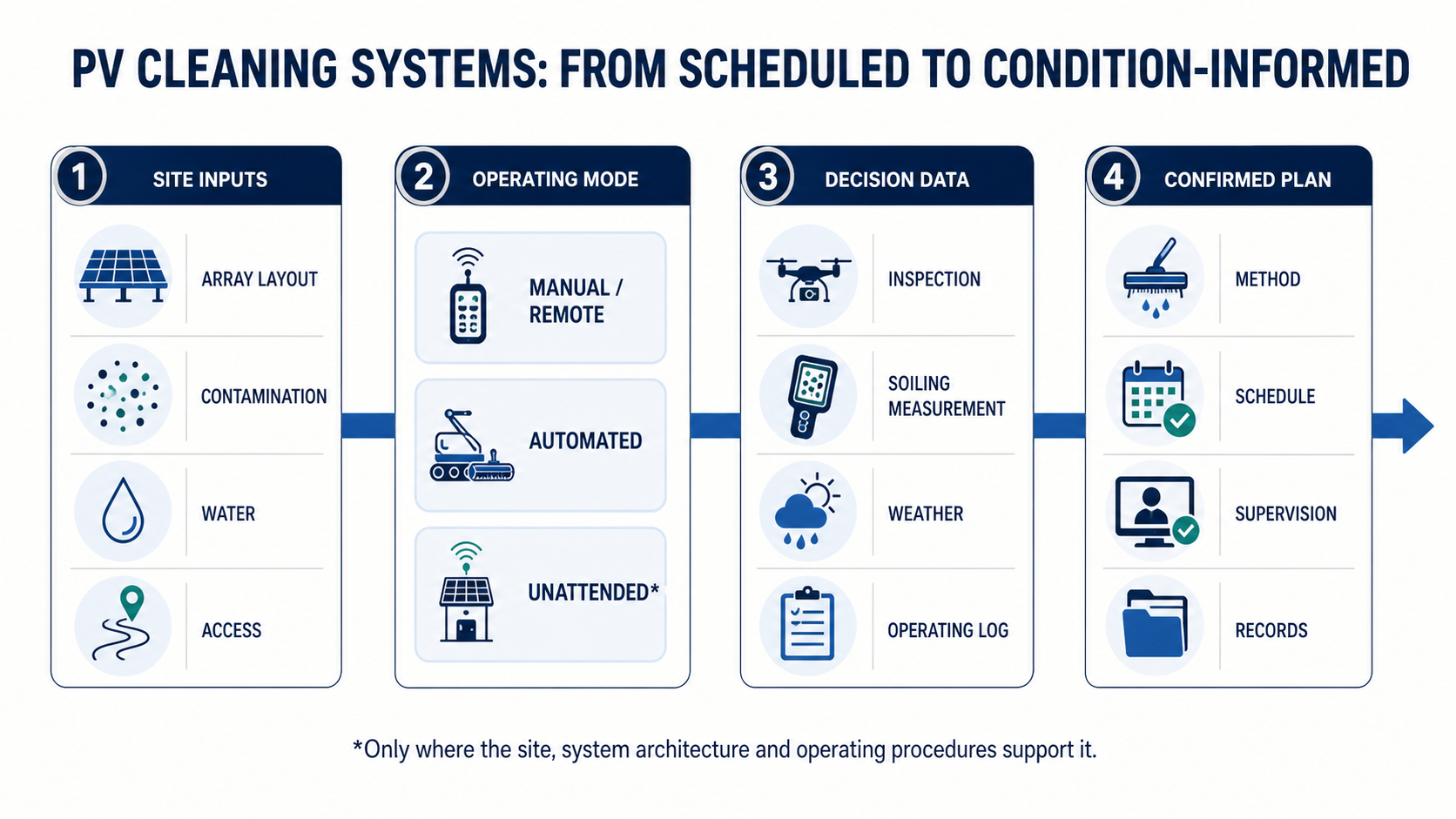
PV module cleaning systems are moving beyond a simple question of whether to clean. In 2026, the more useful question is how a site combines array geometry, contamination, water, access, operating data and human supervision into a repeatable cleaning plan. Automation can help on suitable sites, but it does not remove the need to define system limits, verify cleaning results and plan for exceptions.
Quick takeaways
- A PV cleaning system is a site-level workflow, not just a robot, brush or wash unit.
- Remote control, automated operation and unattended operation describe different operating arrangements. They should not be used as interchangeable sales terms.
- Soiling measurements, inspections and operating records can make cleaning schedules more defensible than a fixed calendar alone.
- Water strategy, equipment transfer, recovery procedures and documentation are often as important as nominal cleaning capacity.
The PV cleaning system landscape
A PV module cleaning system can range from a manually handled brush to a remotely operated mobile machine, an array-specific automated platform, or a fixed/rail-based arrangement. The common job is to remove deposits from modules, but the operating model differs sharply by site.
| Operating arrangement | Typical human role | What must be established before use | Do not infer |
|---|---|---|---|
| Manual or handheld | Performs and supervises cleaning | Access, module guidance, water, weather and safety procedure | That the work is repeatable at scale without records |
| Remote-controlled mobile equipment | Directs movement and handles setup, transfer and recovery | Array geometry, communication range, lifting, charging/water and abnormal-stop procedure | Autonomous navigation or unattended operation |
| Automated system | Configures tasks and intervenes when the procedure requires it | Defined operating envelope, route/array architecture, sensing, exception handling and supervision plan | That every array or condition can run without intervention |
| Unattended arrangement | Maintains the system, reviews alerts and responds to exceptions | Site-specific hardware, monitoring, access control, charging/docking, weather logic, recovery and approved operating procedure | A general capability of every “automatic” cleaner |
The distinction matters because a PV site is not a flat factory floor. Module rows, gaps, slope, edges, cable routing, wind, dust type, water access and transfer paths can all alter the feasible operating model. This is an editorial interpretation of the system-design problem; it is not a claim that a particular Westrong product offers any of the listed capabilities.
Trend 1: Automation is becoming more specific
Editorial assessment: this section describes a procurement and operating-model distinction, not a market-share claim.
What is changing: Buyers are asking more precise questions about what a system can automate: task scheduling, movement on a defined route, water delivery, charging, reporting, fault alerts or a return-to-service process. That is more useful than treating “automatic” as a single feature.
Why it matters: A clear operating definition lets EPC, O&M and procurement teams compare systems on the work that still needs people: loading and unloading, row transitions, inspection, replenishment, supervision, recovery and sign-off. It also prevents a remote-control feature from being represented as autonomous operation.
Adoption constraint: Automation requires a defined operating envelope. Any public claim about route planning, edge detection, docking, fleet control, autonomous recovery or fully unattended operation must be supported by the exact product configuration, a documented procedure and applicable engineering/safety review. [需用户确认: Westrong-specific automation, sensor, docking, fleet or unattended capability and public evidence.]
Trend 2: Cleaning decisions are becoming more data-informed
What is changing: Cleaning decisions increasingly combine inspections with performance or soiling evidence instead of relying on a universal interval. IEA PVPS identifies on-site monitoring, modelling and forecasting among the tools used to understand and mitigate soiling; Sandia research also shows that changing weather and deposition conditions can alter soiling profiles and influence schedule optimisation.12
Why it matters: A fixed interval may still be a sensible starting point for a site, but it should be tested against the site’s own contamination pattern, weather, electrical data and cleaning record. The National Laboratory of the Rockies’ U.S. soiling map illustrates this site specificity: it reports insolation-weighted soiling ratios by location, configuration and year rather than a single national loss factor.3
Adoption constraint: A sensor, inspection image or output trend does not by itself prove that cleaning is the correct response. The team still needs to exclude other causes of underperformance and preserve the measurement method, baseline, units and observation window. Do not publish a cleaning-trigger threshold or expected energy recovery without project-specific evidence.
Trend 3: Water strategy is becoming a design input
Editorial assessment: this section sets a site-review framework; it does not claim a technology-wide adoption rate.
What is changing: Dry, wet and hybrid cleaning are increasingly assessed as different site workflows, not as universal rivals. The right method depends on deposit type and adhesion, module manufacturer guidance, water quality and availability, drainage, climate, brush condition and the approved operating procedure.
Why it matters: Water availability can affect equipment selection, hose routing, storage, pumping, work windows and the records needed to evaluate a cleaning cycle. The same is true when a site avoids water: dry cleaning still requires a method appropriate to the deposits and module surface.
Adoption constraint: No article-level claim should state that one method is always safer, cleaner, lower-cost or more water-efficient. Cleaning instructions and warranty conditions vary by module manufacturer and installation. Where a chemical, water pressure, brush material or temperature restriction is involved, use the module manufacturer’s current documentation and the site’s safety procedure.
Trend 4: Modular deployment and maintainability are part of the system
Editorial assessment: this section reflects the workflow inputs that should be compared for a site; it does not claim a quantified industry trend.
What is changing: The buyer’s evaluation is shifting from machine-only specifications to the full deployment cycle: moving equipment to the array, loading it, changing brushes, managing batteries or water, transferring between areas, handling spares and recording downtime.
Why it matters: Nominal cleaning capacity does not represent complete site throughput if the workflow omits lifting, setup, hose handling, charging, transfer, inspection and recovery. This is especially relevant on distributed rooftops, irregular arrays and multi-zone sites.
Adoption constraint: Portability is not automatically suitability. The engineering review should verify roof load and access, module geometry, array discontinuities, transport configuration, lifting method, weather limits and the personnel procedure. A product page should provide only model-specific, evidenced parameters; this trends article does not recommend a model.
Trend 5: Documentation matters as much as hardware
Editorial assessment: the record fields below are a proposed O&M evidence framework, not a claim about every supplier’s product capability.
What is changing: Cleaning systems are increasingly evaluated by the records they can support: scope, dates, array or zone ID, equipment configuration, operator/supervisor, water or consumables, exceptions, photos where authorised, acceptance method and measured outcome where available.
Why it matters: Documentation connects an O&M action to the evidence needed for the next decision. It gives owners a way to compare planned and actual work, investigate an exception and assess whether a schedule or method should change. IEA PVPS’s 2025 soiling fact sheet similarly frames mitigation around measurement, forecasting and site-specific technology choices rather than a universal cleaning prescription.1
Adoption constraint: A report is only useful if its fields, time window and source data are defined. Do not turn a visual before/after change into a generation, ROI, water-saving or lifetime claim. [需用户确认: Westrong-specific report generation, integrations, data retention and public sample records.]
What still slows adoption
More automation does not erase the practical constraints of PV operations. Before accepting a system concept, assess:
- Array geometry: module dimensions, row length, gaps, frames, tilt, edges, cables and obstacles.
- Access and transfer: lifting, transport, staging, roof/ground routes and recovery paths.
- Contamination: loose dust versus compacted deposits, localised stains, seasonal events and uneven distribution.
- Utilities and environment: water source/quality, drainage, charging, communications, weather and permitted work windows.
- Operating control: who authorises the task, monitors it, stops it, responds to alerts and records completion.
- Evidence: the inspection, baseline and result method needed to decide whether a cleaning action delivered the intended site outcome.
What buyers should ask next
Use the following questions to turn a trend discussion into a procurement or engineering review:
- Which operating mode is actually required: manual, remote-controlled, automated with supervision, or an arrangement designed for unattended operation?
- Which parts of the workflow remain manual, including loading, transfer, replenishment, inspection and recovery?
- What array, roof/ground, module and access conditions define the approved operating envelope?
- What contaminants are present, and how will the selected cleaning method be checked against module guidance?
- Which measurements or records determine the cleaning schedule and verify a completed cycle?
- What documentation, training, spares, maintenance and exception-response plan are included in the commercial scope?
For a category-level comparison, compare PV cleaning equipment by site conditions. To begin a project review, share the site conditions with Westrong Robotics. Final suitability requires confirmed site data, engineering review and an agreed commercial scope.
Frequently asked questions
Is a remote-controlled PV cleaner an automatic cleaning system?
Not necessarily. Remote control describes how an operator directs equipment. An automated system may execute defined tasks with some degree of programmed control, while an unattended arrangement requires a wider site-specific architecture and operating procedure. Use the exact product documentation rather than a generic label.
Should a PV site clean on a fixed schedule or by condition?
Either can be part of a sound plan. A calendar can establish a routine, while inspections, soiling or performance evidence can test whether it remains appropriate. The decision should account for the site’s contamination, weather, access, costs, module guidance and measurement method.
Does a before-and-after image prove energy recovery?
No. It can document visible conditions at a specific time and place. A generation or financial conclusion needs a stated baseline, metric, data source, time window and method that accounts for other performance factors.
Can every PV site use an unattended cleaner?
No. Whether unattended operation is feasible depends on the complete site, equipment architecture, monitoring, charging/docking arrangement, weather logic, access controls, exception handling and approved procedure. It must be verified for the individual project.
References and review note
This article reports external research separately from Westrong Robotics product capabilities. It should be technically reviewed and its links, year, author, route and visual rights checked before publication.
- IEA PVPS, Understanding, Measuring, and Mitigating Soiling Losses in PV Power Systems (September 2025).
- Sandia National Laboratories, Improved PV Soiling Extraction through the Detection of Cleanings and Change Points (2021).
- National Laboratory of the Rockies, Photovoltaic Module Soiling Map (accessed July 24, 2026).