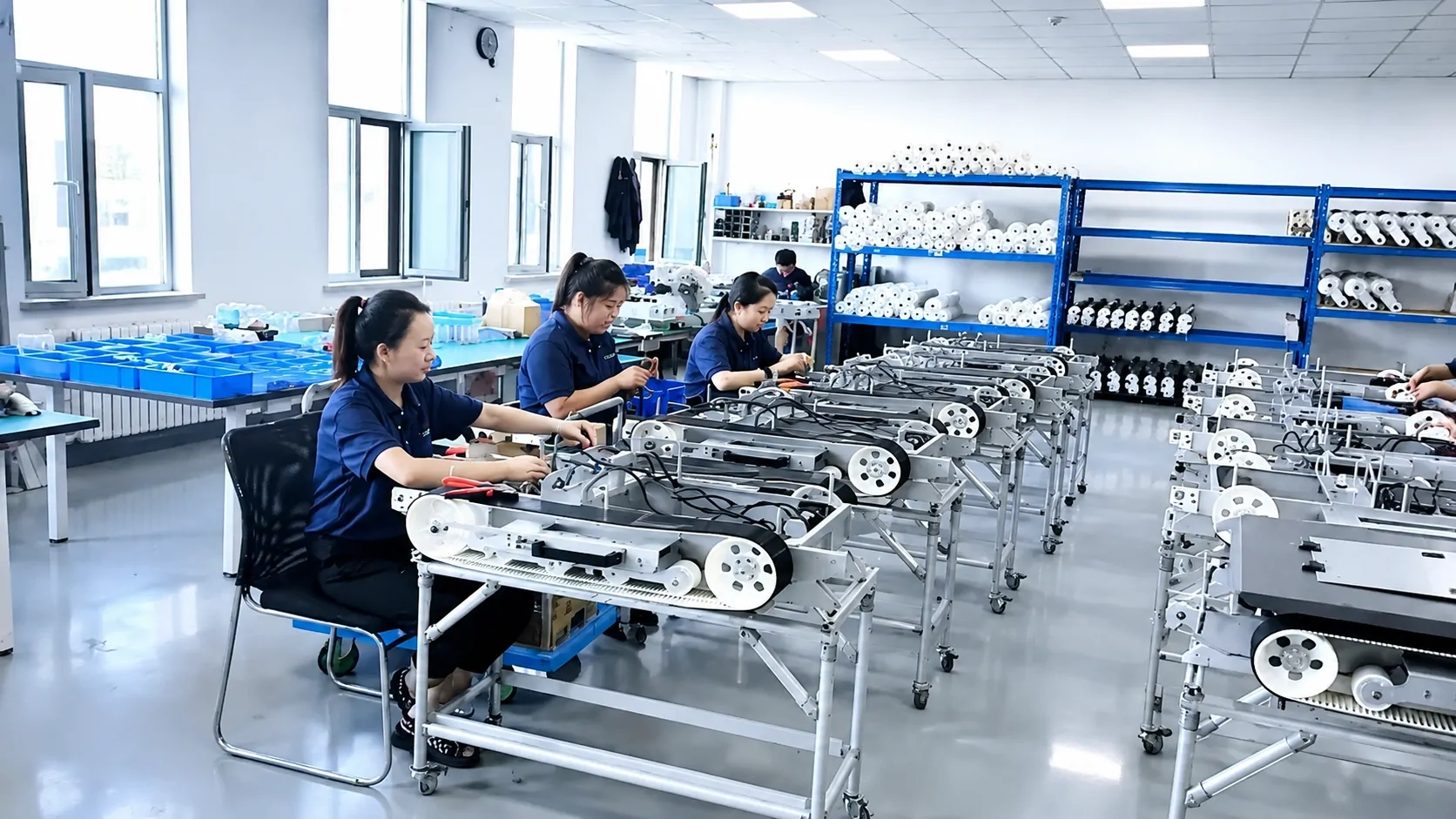
Solar Panel Cleaning Robot Manufacturing Process
Explore our solar panel cleaning robot manufacturing process, from engineering design to final inspection, built for OEM, ODM, and EPC partners.
Manufacturing Control
Requirement Assessment
Clients provide details on the photovoltaic project type, module dimensions, tilt angle, cleaning method, operating environment, and daily operational requirements. Our engineering team
Engineering Design
Process inspections are carried out at critical production stages, Based on project requirements, our team completes the mechanical structure, electrical system, drive system, brush system, battery system, and sensor and control system design.
Component Procurement
Aluminum alloy structural parts, motors, gearboxes, lithium batteries, controllers, sensors, brush assemblies, and electronic components are sourced from qualified suppliers and subjected
Precision Machining
Structural components are manufactured through CNC machining, laser cutting, sheet metal fabrication, welding, and surface treatment, with critical dimensions inspected throughout
Complete Unit Assembly
Following standardized operating procedures, the chassis, traveling module, brush system, electrical wiring, sensors, battery system, and waterproof structure are assembled.
Software Installation and Calibration
Motion control programs, navigation algorithms, sensor parameters, and safety protection logic are installed, followed by operational calibration of the robot.
Functional Testing
Each robot undergoes testing for traveling, steering, brush rotation, water circuit operation, battery endurance, obstacle crossing, climbing, remote control response, and emergency stop
Performance Validation
Complete units are tested on real or simulated photovoltaic modules to verify cleaning efficiency, operating speed, coverage rate, climbing capability, continuous working time, and cleaning
Final Inspection
A 100% inspection is conducted covering exterior appearance, dimensions, electrical safety, waterproof sealing, functional status, accessories, labeling, and technical documentation.
Packaging and Delivery
Products are packed using shock-absorbing foam, reinforced cartons, wooden crates, or export-grade packaging, with moisture-proof, impact-resistant, and fixing treatments applied