
Solar Panel Cleaning Cost and ROI
Understand solar panel cleaning cost drivers, manual vs robotic cleaning economics, and quotation logic for commercial rooftops, utility solar farms, and custom PV sites.
How Commercial Buyers Should Evaluate PV Cleaning Cost
Solar panel cleaning cost is not only the price of a cleaning service or the purchase price of a robot. For commercial rooftops, industrial plants, utility-scale solar farms, floating PV projects, and customized PV structures, the real cost includes labor, access, safety, water use, cleaning frequency, equipment productivity, downtime, and the energy yield impact of soiling. Westrong Robotics recommends evaluating solar panel cleaning cost as a project-based ROI decision. A small rooftop system, a high-dust industrial roof, a desert utility plant, and a non-standard flexible PV structure may all require different cleaning methods, automation levels, and operating plans.
Cost factor | What buyers should check | Why it matters |
|---|---|---|
| PV site type | Commercial rooftop, industrial rooftop, ground-mount, floating PV, agrivoltaic, CSP, or custom structure | Site layout determines access difficulty, cleaning route, robot type, and labor requirement |
| Installed capacity and module area | MW size, number of modules, row length, panel tilt, and array spacing | Larger arrays usually benefit more from higher-efficiency robotic cleaning |
| Soiling type | Dust, sand, bird droppings, pollen, salt mist, industrial contaminants, mud, or mixed deposits | Contamination affects cleaning method, brush choice, water use, and cleaning frequency |
| Cleaning frequency | Weekly, monthly, seasonal, or event-based cleaning | Higher frequency increases manual labor cost but can improve the value of owning equipment |
| Labor and safety | Workers required, work-at-height risk, site access, training, and supervision | Manual cleaning cost includes safety management and repeat labor, not only hourly wages |
| Water availability | Dry cleaning, water-assisted cleaning, water tank version, or water supply constraints | Water logistics can become a major cost item in remote or arid locations |
| Equipment productivity | Cleaning width, speed, battery life, remote-control or automatic operation | Productivity determines how many modules can be cleaned per shift |
| Customization needs | Unusual tilt angle, flexible PV, crawler travel, inspection camera, dust collection, or non-standard module layout | Custom development changes the quotation logic and delivery timeline |
Comparison: Robotic Equipment vs. Manual Solar Panel Cleaning
Westrong Robotics Solar Panel Cleaning
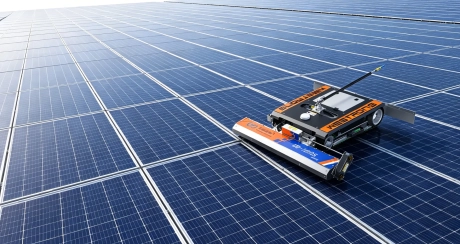
Equipment & Adaptability
Modular robotic system adapts to any solar array layout — maximizing coverage for every solar panel cleaning session
Cleaning Efficiency
Full 360° coverage across all solar panels — 8–10× faster than manual solar panel cleaning
Impact on Solar Panels
Anti-slip, anti-collision design — thorough solar panel cleaning with zero micro-cracks and no effect on power output
Personnel & Safety
Intelligent safety protocols enable safe, automated solar panel cleaning with 60%+ fewer staff
Power Generation Gain
Full-array solar panel cleaning every cycle delivers 8%+ higher energy yield vs. manual methods

Manual Solar Panel Cleaning
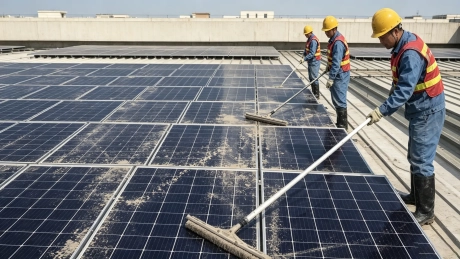
Equipment & Adaptability
Basic long-handled brushes; unable to safely reach elevated solar panels
Cleaning Efficiency
Slow, inconsistent, and prone to missed panels — cleaning quality varies widely
Impact on Solar Panels
Risk of physical impact during cleaning, causing micro-cracks, coating damage, and shortened panel lifespan
Personnel & Safety
Manual cleaning in live PV zones is hazardous — high headcount, high labor and management costs
Power Generation Gain
Uneven cleaning results in variable soiling levels and measurable losses in power generation
When Robot Ownership Makes More Economic Sense
Robot ownership is usually easier to justify when one or more of these conditions apply
The PV site has a large module area or repeated cleaning demand.
Manual access is difficult, risky, or costly.
The site is exposed to heavy dust, sand, industrial pollution, salt mist, or frequent bird droppings.
Cleaning quality needs to be standardized across many rows or multiple plants.
The buyer operates as an O&M company, EPC, distributor, or asset owner managing several PV projects.
The project requires dry cleaning, water-assisted cleaning, or custom robot configuration.
ROI Calculation Logic for Buyers
A practical ROI model should compare the current cleaning method with the proposed robotic or service-based plan
ROI input | Buyer data needed |
|---|---|
| Current cleaning cost | Labor, contractor fee, mobilization, water, safety supervision, equipment rental, and downtime |
| Cleaning frequency | Number of cleaning cycles per month or year |
| Production loss from soiling | Before-cleaning and after-cleaning generation data where available |
| Robot productivity | Cleaning efficiency, operating hours per shift, battery cycle, and operator count |
| Equipment lifecycle cost | Robot price, consumable parts, spare batteries, maintenance, training, and expected usage period |
| Risk reduction | Reduced work-at-height exposure, more repeatable process, and lower dependence on large cleaning teams |